The COACH Method
The 5-Step Framework That Guides Every Coaching Conversation
You understand what coaching is. You know what makes it effective. But when you're sitting across from a client who's stuck, frustrated, or overwhelmed—what do you actually say?
This is where most new coaches panic. They know they should ask questions, but which ones? In what order? How do you guide a conversation from "I'm stuck" to "I know exactly what to do"?
That's what the COACH Method solves.
It's a systematic, repeatable framework that transforms messy problems into clear action—through self-discovery, not advice-giving.
Master this method, and you'll never walk into a coaching session wondering what to do next.
What Is The COACH Method?
The COACH Method is a systematic approach to help people transform through self-discovery.
Three things make it work:
1. It's systematic - There's a clear order to follow
2. It transforms - It creates real change, not just conversation
3. It's self-discovery - Clients find their own answers
Why it works: It's not just a coaching tool—it's a problem-solving framework. The structure naturally guides people from confusion to clarity, from stuck to action.
The result: Self-identified, willful action from your client. Not your ideas they might try. Their ideas they're committed to executing.
The COACH Framework: Overview
COACH is an acronym for the five stages of every coaching conversation:
C - Change
O - Objective
A - Anchors
C - Choices
H - How
Here's how it flows:
C - Change: What do you want to change most right now?
(Get the broad overview—don't dive into details yet)
O - Objective: What does success look like specifically?
(Make it measurable, time-bound, and crystal clear)
A - Anchors: What's stopping you from achieving this?
(Identify everything that could get in the way—past, present, and future)
C - Choices: What could solve this problem?
(Brainstorm all possibilities without commitment)
H - How: What will you actually do?
(Select specific actions and commit to execution)
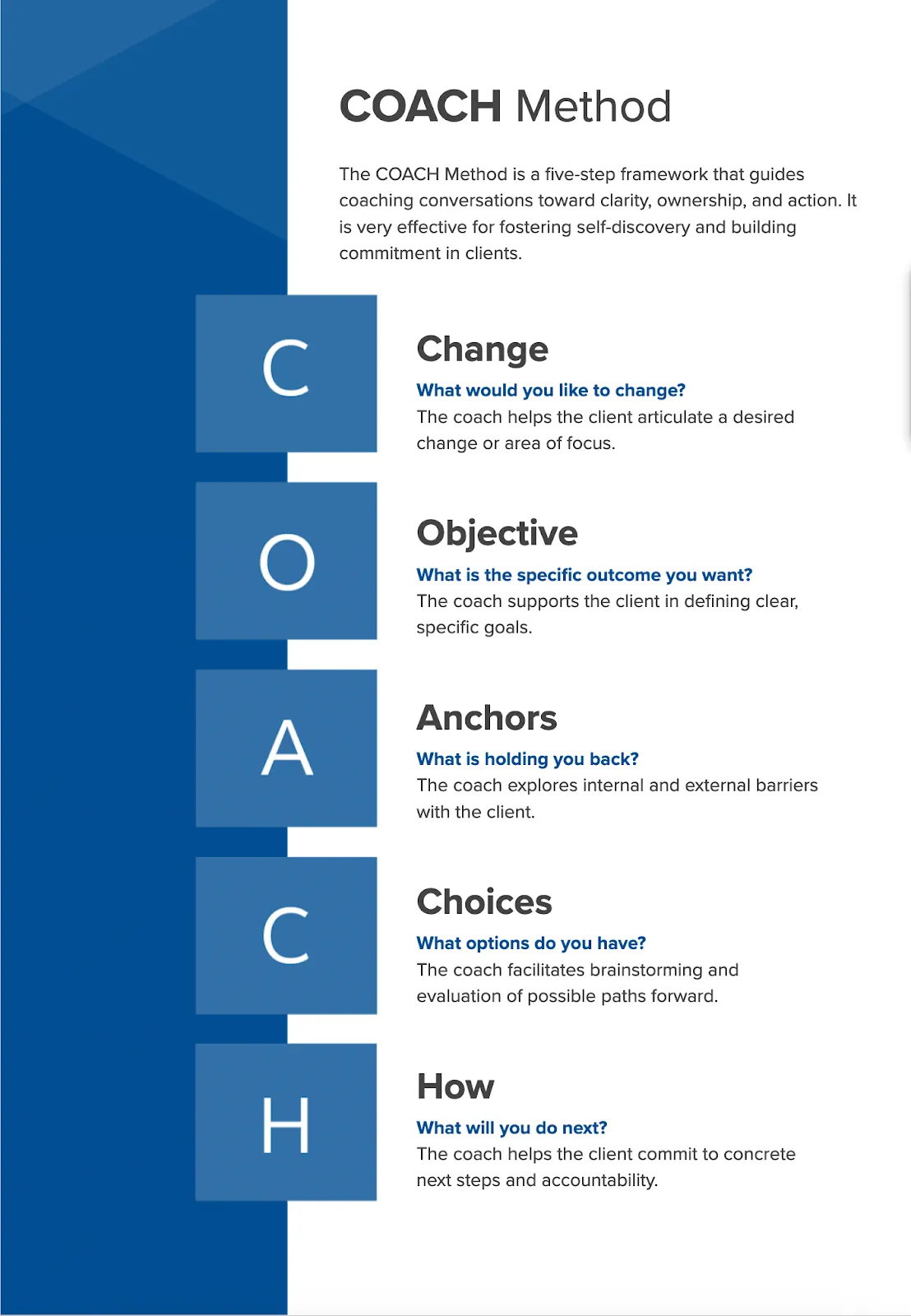
The power of this Method: When you follow this order, clients naturally move from vague frustration to committed action in a single conversation.
Breaking Down Each Step
C = Change (The Focus Area)
What you're doing: Getting the big picture without diving into details yet.
Key questions:
"What do you want to change most right now?"
"What's keeping you awake at night?"
"What's the most important thing to address in the next 90 days?"
Why this matters:
If you get too detailed too quickly, you might solve the wrong problem. This stage creates space for free thinking—letting the real issue surface.
What you're looking for:
A broad sense of what they want to be different. Not the solution. Not the details. Just the area of focus.
Optional at this stage:
Ask about basic consequences—"Why does this matter to you?" You'll go deeper in the next stage, but getting an initial sense helps.
O = Objective (The Specific Outcome)
What you're doing: Making the change specific, measurable, and time-bound.
Key questions:
"What does success look like specifically?"
"How will you measure this?"
"When does this need to be achieved by?"
"What happens if you achieve this? What happens if you don't?"
Why this matters:
Vague goals create vague action. You need crystal clarity on what "done" looks like before you can figure out how to get there.
What you're looking for:
Specific and measurable - No ambiguity about what success looks like
Time-bound - A clear deadline
Deep consequences - Why this truly matters (personally and professionally)
Don't move forward until you have this nailed. If the objective isn't clear, everything that follows will be fuzzy.
A = Anchors (The Roadblocks)
What you're doing: Identifying everything that's stopping progress—past, present, and future.
Key questions:
"What's stopped this from happening before?"
"What's stopping you right now?"
"What might stop you in the future?"
"What barriers do you see?"
"What challenges can you foresee?"
Why this matters:
This is the most important stage. If you don't understand what's actually in the way, your solutions won't work. Most people jump straight to solutions without identifying the real problem—that's why nothing changes.
What you're looking for:
A complete assessment of everything that could derail progress:
Business challenges (cash flow, systems, team)
Personal barriers (fear, procrastination, limiting beliefs)
External factors (family, time, resources)
Be exhaustive here. The better you understand the anchors, the better your solutions will be.
The Anchors Grid: Looking Beyond the Obvious
Don't just focus on business issues. Use this grid to explore three dimensions across three timeframes:
Past
Present
Future
Self (emotions, thoughts, beliefs)
What stopped you before?
What's stopping you now?
What might stop you?
Others (family, team, support)
Who wasn't supportive?
Who isn't bought in now?
Who might resist?
Business (systems, resources, skills)
What was missing?
What's lacking now?
What challenges ahead?
Example filled grid:
Past
Present
Future
Self
Fear of failure
Procrastination
Doubt I can sustain it
Others
Team wasn't aligned
Family needs more time
Might lose key person
Business
Lacked systems
Cash flow tight
Market could shift
Use this grid mentally or literally—it ensures you cover everything from every angle.
C = Choices (The Brainstorm)
What you're doing: Exploring all possible solutions without commitment.
Key questions:
"What choices do you have?"
"What could solve this?"
"What else?"
"What else?"
"What else?"
Why this matters:
Humans naturally jump to the first solution that comes to mind. That solution rarely works because it hasn't been thought through. This stage forces creative thinking—exploring multiple options before committing to one.
What you're looking for:
A brainstorm of everything that could work:
Realistic options
Creative options
Even unrealistic options (they often spark better ideas)
This is NOT where you decide what to do. That comes next. This is pure exploration with no commitment.
Keep asking "What else?" until you've exhausted all possibilities.
H = How (The Action Plan)
What you're doing: Selecting the specific actions they'll commit to.
Key questions:
"Which of these will you take forward?"
"Does this get you to your objective?"
"Does this overcome all the anchors?"
"What specifically will you do?"
"When will you do it?"
"How will I know you've done it?"
Why this matters:
Everything leads to this. Without committed action, coaching is just a nice conversation.
What you're looking for:
Specific actions - Clear, concrete steps
Client commitment - They chose it, not you
Solves the anchors - Addresses the real roadblocks
Achieves the objective - Gets them to the measurable outcome
Accountability built in - Checkpoints and follow-up
Check back to the objective: Does this action actually get them there? If not, you're not done yet.
Check against the anchors: Does this overcome all the roadblocks? If not, go back to Anchors and dig deeper.
Critical Rules for Using COACH
1. Stay in Order
Follow the framework systematically: Change → Objective → Anchors → Choices → How.
Why: Each stage builds on the last. Skip steps and you'll miss critical information.
Common temptation: Clients will want to jump straight to solutions. Bring them back. Say: "I hear you have ideas—let's capture those in a moment. First, I want to make sure we fully understand what we're solving for."
2. Avoid Jumping from Objective to How
The biggest mistake: Going straight from "What do you want?" to "What will you do?"
Why it fails: You haven't identified what's actually stopping them (Anchors) or explored all options (Choices).
The discipline: Resist the urge to skip ahead, even when the solution seems obvious.
3. Expect Multiple Areas of Focus
What happens: As you dig deep, you'll often uncover multiple problems that need attention.
What to do: Don't try to solve everything at once. Ask: "We've uncovered several important areas. Which one is most important to focus on right now?"
Then start COACH again with that specific focus.
4. If the How Doesn't Solve the Objective
What this means: The action plan doesn't actually achieve the goal or overcome the roadblocks.
Where you went wrong: Almost always in Anchors—you didn't dig deep enough.
What to do: Go back to Anchors, explore further, then move through Choices again before committing to How.
5. This Is Self-Discovery, Not Advice-Giving
The challenge: You have years of experience. You'll know the answer. You'll want to tell them.
The discipline: Don't. Ask questions instead. Help them discover it.
Why: When they find the answer themselves, they're committed. When you tell them, they're doing you a favor.
What Makes COACH Powerful
It's a structured dialogue - You're not winging it; you're following a proven system
It's self-discovery - Clients find their own insights, which creates ownership
It leads to action - Everything builds toward committed, executable steps
It's repeatable - Use it in every session with every client
It works fast - What used to take hours now takes 30-45 minutes
Real-World Impact
This framework has been used daily for 16+ years by experienced coaches. Here's what they report:
"I could kind of get results before, but once I learned COACH, I achieved the same outcomes with way higher engagement in about a quarter of the time."
Even coaches earning £30,000-£50,000 per month say: "This absolutely changed how effective I am."
This isn't just for beginners. This is the framework that makes good coaches exceptional.
What's Next?
You now have the structure—the step-by-step process for guiding any coaching conversation.
But structure alone isn't enough. You also need the skills—the competencies that make each stage of COACH truly transformational.
That's where the POWER Framework comes in.
Ready to develop the five essential coaching competencies? Explore the POWER Framework and learn how to make every question powerful, every insight deeper, and every action more committed.
The POWER Framework
Master These 5 Competencies and Transform Your Coaching
Escape Plan Checklist
Your step-by-step roadmap to building a six-figure coaching business with every action item, estimated time, and link to the resources you need.
Disclaimer
Any results shared are not typical and are not a guarantee of your success. Your results will vary depending on your education, effort, application, experience, and background. Business Coach Academy provides coaching certification and business training. We cannot guarantee that you will make money, sign clients, or achieve success if you employ our strategies. Your results may significantly vary from those of our founders and other members. Client testimonials and case studies represent individual results and are not typical. Due to the sensitivity of financial information, we do not track the typical results of all students.
We do not provide investment, tax, legal, or other professional advice. Specific client stories, income figures, and experiences mentioned on this website are for informational and illustrative purposes only. Building a coaching business requires significant effort, skill development, and time. Success depends on many factors including your existing network, business acumen, coaching ability, and market conditions.
The information contained within this website is the property of Business Coach Academy. Any use of the images, content, or ideas expressed herein without the express written consent of Business Coach Academy is prohibited.
Copyright © 2025 Business Coach Academy. All Rights Reserved.