The Problem
Your Corporate Job Isn't Safe — And It's Making You Miserable
You've done everything right.
You climbed the ladder. You earned the title. You delivered results year after year. You sacrificed weekends, missed family events, and proved your worth over and over again.
But something's wrong.
You feel trapped.
Stuck in a role that was supposed to be the reward for decades of hard work, but instead feels like a prison. You value your family, but you're afraid you're not spending enough quality time with them. And even when you're physically present, you're not really there—your mind is still occupied with work pressure, hard problems to solve, and tougher deadlines to meet.
If you have kids, maybe you're afraid you'll miss them growing up. Maybe you even think of yourself as a bad parent sometimes.
On the other hand, you also feel like you're losing your potential day by day. Maybe you've outgrown your company. Maybe you don't even feel safe in your current role anymore—you see what's happening around you and suspect you might be dismissed soon.
You know something isn't working. You know there's a better way to live. But it feels too risky to change anything—and you don't even know where to start.
Here's the uncomfortable truth: The corporate career you were promised no longer exists.
And if you're waiting for things to go back to normal, you're going to be waiting forever.
The world has changed. And if you don't adapt, you'll either be pushed out—or burn out trying to hold on.
Let's talk about what's actually happening.
The Reality for Senior Directors in 2025
The climate for Managing Directors, VPs, CEOs, Sales Directors, and Marketing Directors in the UK and US is uniquely volatile in 2025. There are new and specific risks for higher-level executives, coupled with a surge in both burnout and those pursuing independent careers.
This isn't just affecting junior staff anymore. Senior roles are now regularly targeted in layoffs.
Senior Executives Are No Longer Protected
In high-profile cases across the UK and US—PwC, Santander, Intel, Clarks—layoffs have extended from junior staff to Managing Directors and VPs, roles historically seen as more secure.
The Big Four accounting firms (PwC, KPMG, EY, Deloitte) illustrate this shift perfectly. Their 2025 workforce reductions in the US and UK have included associates, managers, and managing directors, reflecting a fundamental change in mindset about whose roles are at risk—especially as automation and AI reshape demand at the top.
The numbers tell the story:
Senior roles are being eliminated at unprecedented rates
The average experience level of those laid off is 12+ years
These aren't underperformers—they're experienced, high-paid executives with deep expertise
Most are still looking for work months later
Here's what makes this different: Your decades of experience are now seen as expensive overhead that can be replicated by a junior analyst with AI tools and the right prompts.
For directors in the UK specifically, the risk profile now includes heightened regulatory and legal exposure, with emerging regulations making directorships more complex and exposed to personal liability.
Independent and non-executive directors are in rising demand for their ability to navigate governance, AI, cyber, and ESG—but the stakes and expectations are higher than ever.
Executive Burnout Is Peaking
Even if your job is secure for now, there's another crisis: The role is destroying you.
In 2025, 70% of C-suite executives in the US and UK have considered resigning for mental health reasons—a sharp jump from pre-pandemic years and a reflection of "crisis fatigue," relentless pressure, and a lack of internal support networks.
Senior leaders face "invisible stressors" including:
Reputational risk
Decision overload
Loneliness at the top
Constant pressure to do more with less
The cost of this burnout is staggering: Over $20,000 per executive annually due to disengagement and turnover.
The rate of severe or extreme burnout among directors is higher than general employee populations:
35% in the UK report extreme burnout
Over half of all US executives report multiple burnout episodes
This isn't just about feeling tired. It's about:
Working longer hours than before the pandemic (37% of executives)
Being caught between team demands and board expectations
Sacrificing health, relationships, and well-being for a company that views you as replaceable
The Mayo Clinic defines burnout as a state of physical or emotional exhaustion, coupled with a sense of reduced accomplishment and loss of personal identity.
Sound familiar?
The Great "Leadership Reset"
Something shifted in the past few years. The pandemic forced executives to step back and ask hard questions:
Is this what I want? Is this worth it? Is there another way?
Many discovered the answer was no.
This isn't The Great Resignation of 2021—this is the "Great Leadership Reset." Senior executives aren't leaving impulsively. They're making intentional shifts, pursuing independent work, consulting, or portfolio careers that give them:
Validation
Balance
Control over their own time, income, and work style
The numbers are striking:
The number of full-time independent workers in the US doubled from 2020 to 2024, with a substantial share coming from senior leadership roles
84% of those who left senior roles for independent work report greater health and security
68% of independent workers say independent work is less risky and more secure than traditional employment—up from just 32% in 2011
Read that again: Independent work is now seen as LESS risky than corporate employment.
Your peers aren't struggling. They're thriving. They're building consulting practices, taking fractional executive roles, coaching other leaders, and finally spending time with their families.
The Three Forces Converging on You Right Now
Let's be clear about what you're facing:
1. Job Insecurity
AI and automation are displacing senior roles. Layoffs are targeting experienced, high-paid executives. The job market for senior leaders has fundamentally changed. Your role isn't as safe as you think.
2. Burnout and Dissatisfaction
You're working longer hours, dealing with more stress, and sacrificing your health and relationships. The role that was supposed to be the reward has become a trap.
3. A Closing Window of Opportunity
Your expertise has never been more valuable—but the window to leverage it on your own terms won't stay open forever. The longer you wait, the harder it becomes to transition.
When You Put These Forces Together
Your corporate job is not only bad for your well-being—it's not even a safe option anymore.
The "stable" career path of climbing the ladder, staying loyal, and retiring with a pension? That's gone.
Companies are replacing expensive senior talent with leaner teams powered by AI. They're cutting costs at the top, not the bottom. And when efficiency demands it, they will replace you—regardless of your years of service, your expertise, or your loyalty.
The harsh reality: Your company doesn't care about you. When the numbers demand it, you're a line item to be optimized.
Meanwhile, you're sacrificing:
Your health (burnout, stress, exhaustion)
Your relationships (missing family time, not being present)
Your potential (feeling stuck, losing yourself)
Your security (at risk of layoff despite your experience)
For what? A title? A salary that gets taxed into oblivion? The "prestige" of being perpetually exhausted?
The Path Forward Exists
Here's the good news: You don't have to stay trapped.
There's a proven path that allows you to:
Leverage your expertise without sacrificing income
Build autonomy and control over your time
Do work that actually matters and transforms businesses
Create security that can't be taken away by restructuring or AI
Finally have the life you've been working toward
Experienced executives like you are making this transition every day—not by taking reckless risks, but by following a systematic, strategic plan.
That's exactly what this guide is about.
Ready to see what the path forward looks like? Continue to "The Path Forward" and discover the three phases that take you from corporate trapped to independently thriving.
The Solution
How to Leverage Your Expertise Without Starting From Scratch
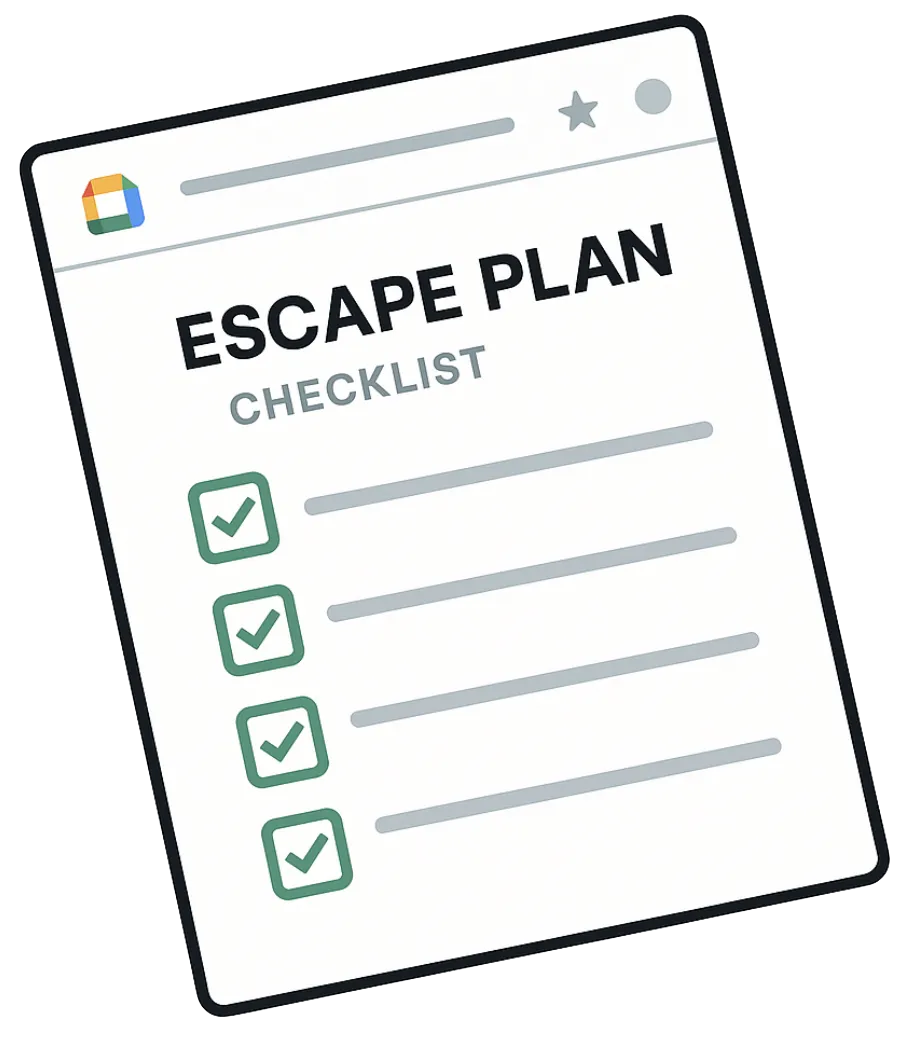
Escape Plan Checklist
Your step-by-step roadmap to building a six-figure coaching business with every action item, estimated time, and link to the resources you need.
Disclaimer
Any results shared are not typical and are not a guarantee of your success. Your results will vary depending on your education, effort, application, experience, and background. Business Coach Academy provides coaching certification and business training. We cannot guarantee that you will make money, sign clients, or achieve success if you employ our strategies. Your results may significantly vary from those of our founders and other members. Client testimonials and case studies represent individual results and are not typical. Due to the sensitivity of financial information, we do not track the typical results of all students.
We do not provide investment, tax, legal, or other professional advice. Specific client stories, income figures, and experiences mentioned on this website are for informational and illustrative purposes only. Building a coaching business requires significant effort, skill development, and time. Success depends on many factors including your existing network, business acumen, coaching ability, and market conditions.
The information contained within this website is the property of Business Coach Academy. Any use of the images, content, or ideas expressed herein without the express written consent of Business Coach Academy is prohibited.
Copyright © 2025 Business Coach Academy. All Rights Reserved.